

Shipping musical instruments safely
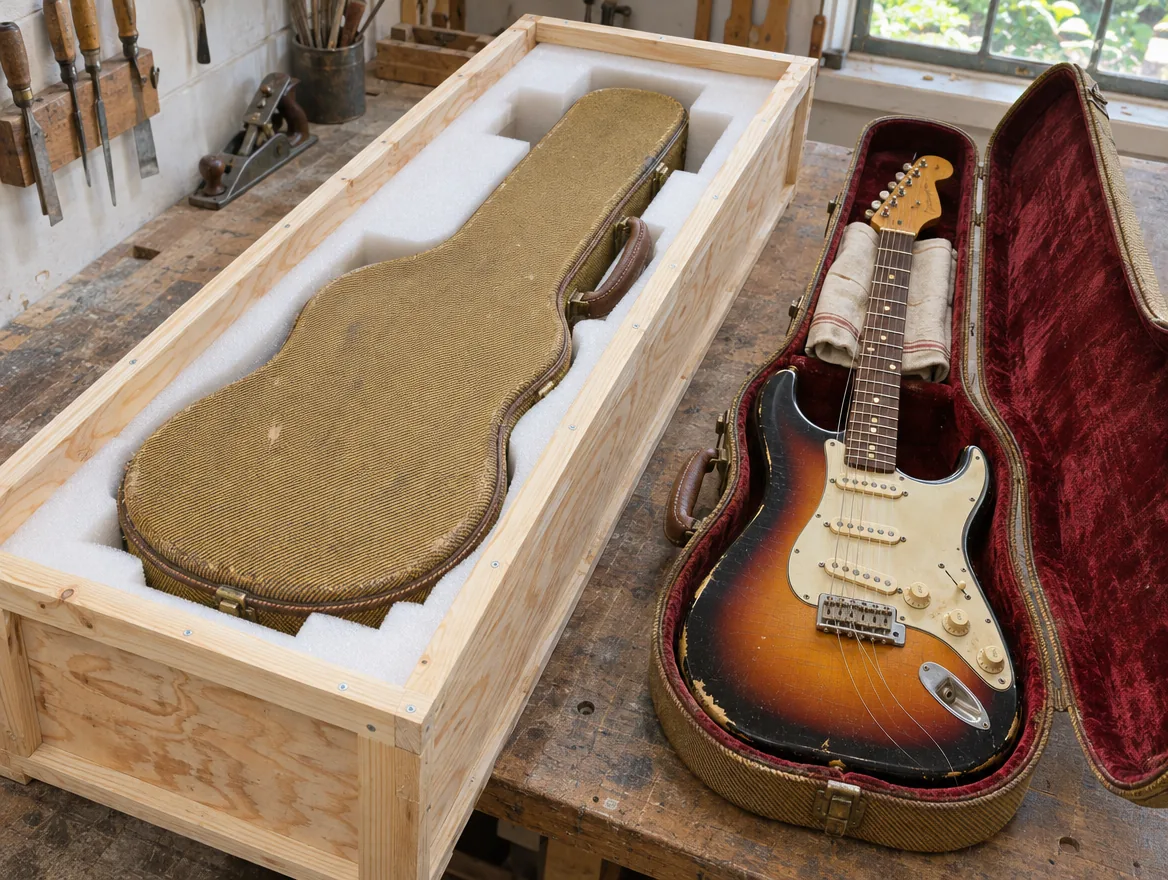
Shipping musical instruments safely starts with the hard case and doesn't stop there. We put guitars, violins, cellos, saxophones, trumpets and clarinets in their cases inside a crate, hold the case in cut foam so it can't move, and pack mouthpieces, reeds and loose parts on their own, so a valuable instrument arrives the way it left.
- Instruments
- Guitars, violins, cellos, brass, woodwind
- Packed
- Hard case inside a crate
- Held in
- Cut foam, nothing loose
- Two ways
- We collect it, or built to your sizes
What does shipping musical instruments involve?
Shipping musical instruments means protecting two things: the instrument from knocks, and its set-up from strain. A guitar neck under full string tension, a violin bridge held up only by its strings, a mouthpiece left in a trumpet: each is a small risk on a sofa and a real one on a lorry. We pack every instrument for the way it's built.
Strings slackened, neck and headstock supported, the case filled so nothing moves.
Bridge and soundpost thought about first, with your luthier's advice.
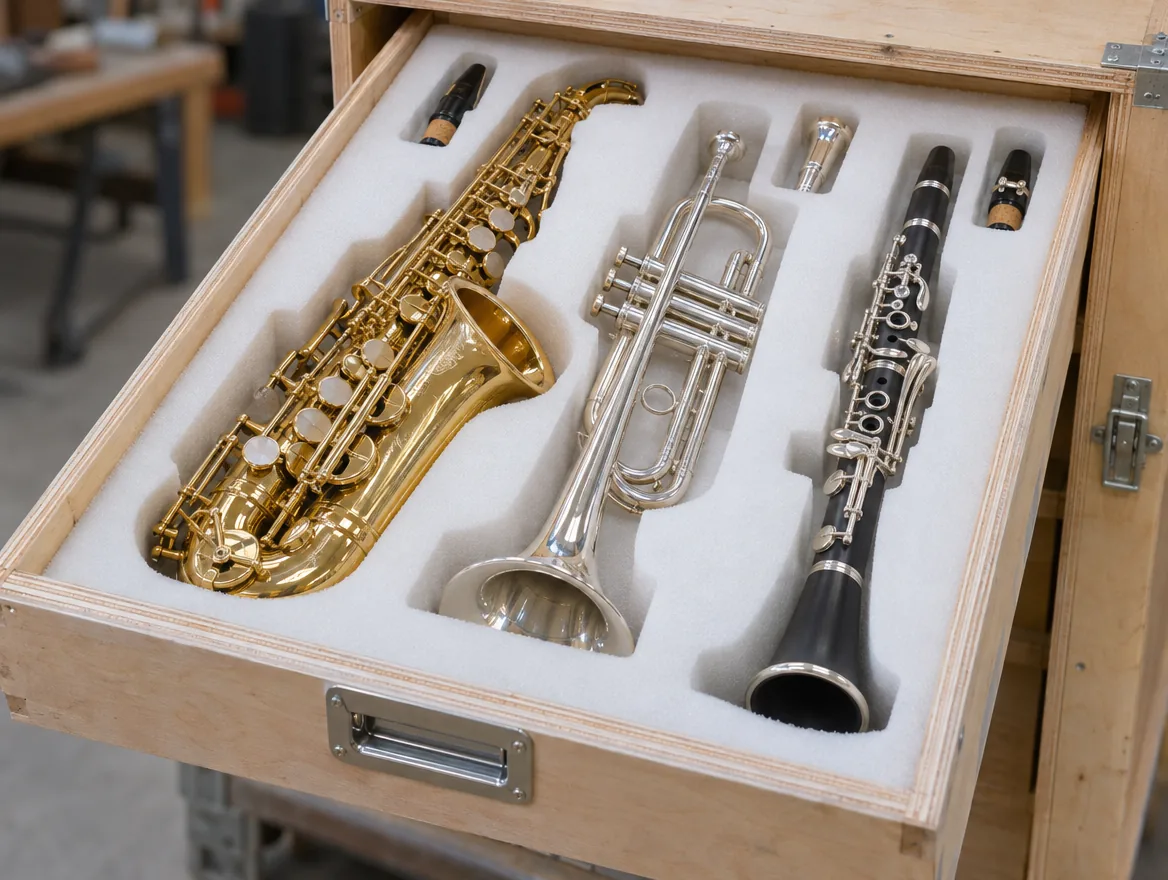
Mouthpieces out, each instrument in its own cut foam cavity.
Reeds and mouthpieces apart, wooden bodies kept from sudden cold.
Why a hard case alone isn't enough
A good hard case protects an instrument carried by its owner, in a car or into a rehearsal room. It isn't made for freight. On its own, a case can be stacked under heavy boxes, dropped flat or loaded on its end, and its catches and handle break easily. Couriers' own packing guides say the same: the instrument goes in its case, and the case is packed again.
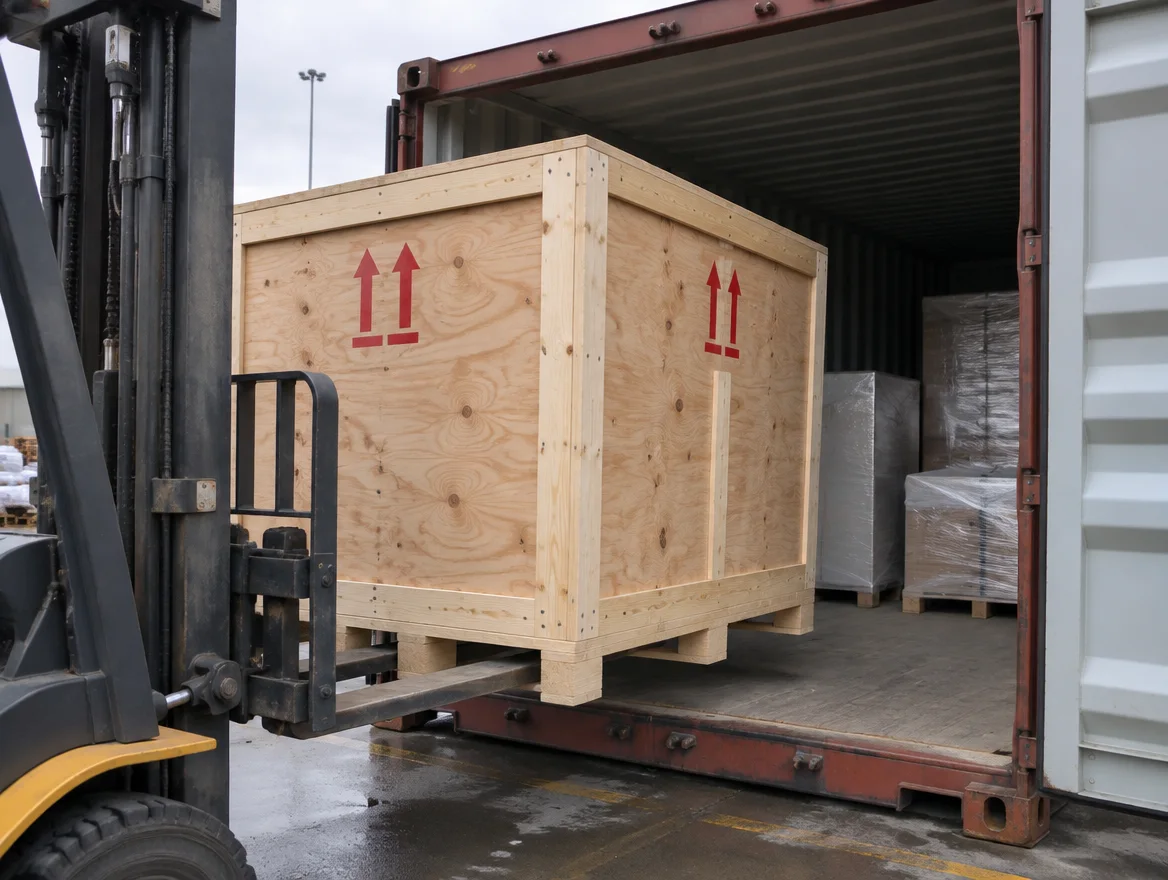
So the case goes inside a crate. The crate takes the knocks and the handling; cut foam around the case holds it still.
Case inside crate, foam all round, and nothing loose inside the case. Two layers between the instrument and the outside world.
How to ship a guitar
To ship a guitar safely, slacken the strings, support the neck so the headstock carries nothing, fill the case so the guitar can't move, then hold the case in foam inside a crate. The same steps work if you're preparing a guitar yourself.
Angled headstocks are the classic break on a shipped guitar. On arrival it will need tuning back up, and may need a set-up from your guitar tech.

- 01Photograph it
Front, back, sides, headstock and any marks, so its condition is on record.
- 02Slacken the strings
Well below pitch, but left on. Less tension means less strain on the neck, and a headstock under less tension is less likely to crack in a knock.
- 03Mind the bridge
On archtops and other guitars with a floating bridge, the bridge is held only by the strings. Mark its position, keep a little tension, and pad round it.
- 04Support the neck
Pad under the neck so it rests evenly. Don't jam padding under an angled headstock, as that can lever it in a knock.
- 05Fill the case
Soft padding round the body and headstock until the guitar doesn't move when the case is shaken. Don't rely on the neck rest alone.
- 06Empty the pocket
Take capos, slides, tuners and anything heavy out of the accessory compartment, and pack them separately. Take off a tremolo arm.
- 07Case into the crate
The case sits in cut foam inside a crate, held on every side, marked This way up.
| Guitar | Strings | Watch for |
|---|---|---|
| Steel string acoustic | Slackened well below pitch | Angled headstock, top and bridge |
| Electric | Slackened | Tremolo arm off, angled headstocks, pickups and knobs |
| Classical (nylon) | Slackened | Thin top and a headstock with open slots |
| Archtop and jazz | A little tension kept | Floating bridge: mark its position and pad round it |
Violins, violas and cellos: the bridge and soundpost
Here the advice on strings is different from guitars. A violin's bridge isn't glued: it stands on the top, held only by the pressure of the strings, and inside, the soundpost is held by that same pressure. Slacken the strings completely and the bridge falls and the soundpost can drop, and a luthier must set it up again.
So there are two ways to prepare one, and the right choice is for the owner and their luthier:
- Bridge up. The strings are lowered a little but kept tight enough to hold the bridge upright and the tailpiece off the top, and the case is padded round the bridge, scroll and chin rest.
- Bridge down. Some dealers ship valuable instruments with the bridge and soundpost down, for a luthier to set up again at the other end.
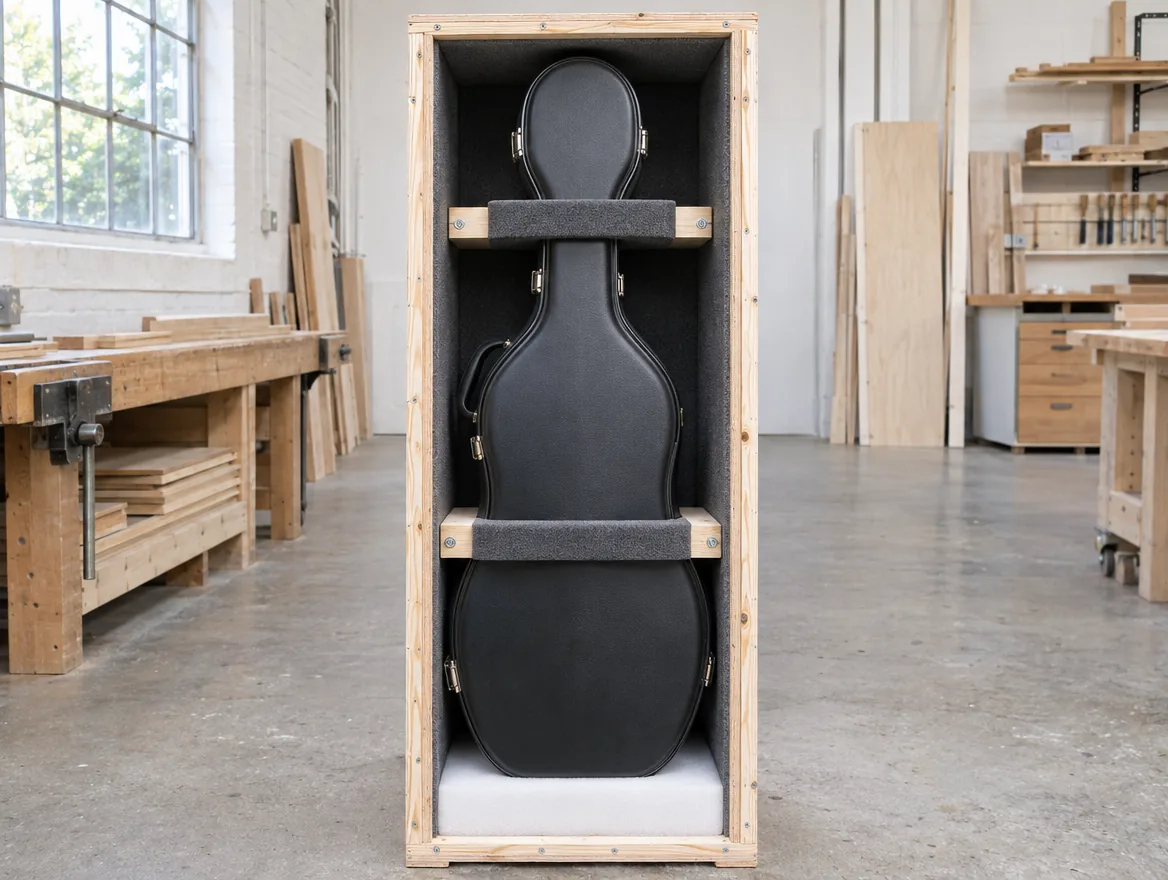
Either way, the bow hair is loosened and bows are secured in their clips. A cello travels upright in its hard case, endpin in, held in the crate by padded battens and a full-length foam base.
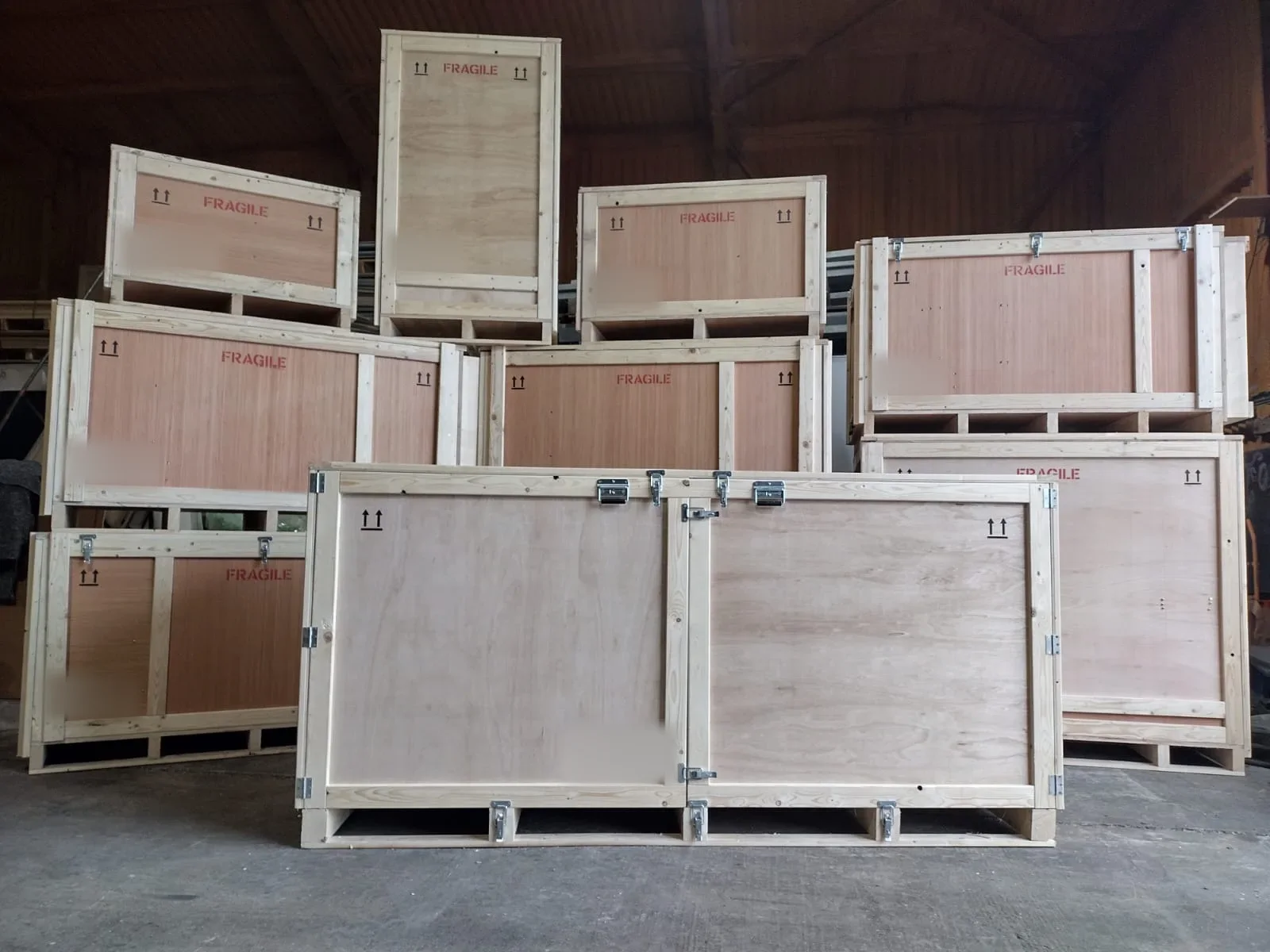
Send us a photo and the measurements.
We’ll recommend the crate, the lining and the supports, and come back with a bespoke quote.
Brass and woodwind in cut foam
Brass and woodwind travel best in cut foam: a cavity cut to the shape of each instrument or its case, supporting the body along its whole length.
- Mouthpieces come out. Left in a trumpet or a trombone, a mouthpiece can be driven into the leadpipe by a knock and jam there. So they travel wrapped, in their own space.
- Reeds travel apart. Clarinet and saxophone reeds go in a reed case, packed separately, as a reed left on a mouthpiece is easily split.
- Necks and crooks. A saxophone neck comes off and travels in its own space, never left in the body. Clarinet joints are packed apart, as they are in the case.
- Oils and liquids. Valve oil, slide grease and cork grease come out of the case, so nothing can leak onto lacquer, pads or the lining.
The foam holds the body, so a bell rim or a key never carries any weight.
Temperature and humidity
Wood swells in damp air and shrinks in dry air, and quick swings do the most harm: cracked tops, fret ends sticking out of a dried-out fingerboard, open seams on a violin. Wooden clarinets are known to crack when a cold instrument is warmed too quickly, or played cold.
A closed case inside a lined crate slows those changes down. At the other end:
- Let the crate stand indoors for a day or so before opening it
- Then leave the case closed for a few hours more, so the instrument warms up slowly
- Keep it away from radiators, fires and sunny windows at first
- Check the strings, bridge and seams, and tune back up gradually
- Ask your luthier, guitar tech or repairer to look it over after a long journey
CITES: rosewood, ivory, tortoiseshell and other materials
Some instruments contain materials from protected species, and can need permits even when old.
- Brazilian rosewood (Dalbergia nigra) is on CITES Appendix I, its strictest list, and many vintage guitars have it. An instrument made with it needs CITES paperwork to leave the UK, and the date it was made matters: GOV.UK points out that many rosewood guitars were made after 1947, so they don't count as old worked specimens.
- Other rosewoods. Since 2019, finished musical instruments, parts and accessories made with other Dalbergia rosewoods have been exempt from the CITES controls on those woods. The exemption doesn't cover Brazilian rosewood.
- Ivory and tortoiseshell. Old nuts, saddles, bridges, tuning keys, inlays and bow fittings can be ivory or tortoiseshell. GOV.UK lists guitars with ivory bridges, fretboards or tuning keys, and clarinets with ivory ferrules or banding, among items usually treated as worked specimens, and says a CITES permit is still needed to export them. Selling an instrument with elephant ivory also falls under the Ivory Act: instruments made before 1975 with less than 20% ivory can be registered for an exemption.
- Bows. Many fine bows are made of pernambuco, which is also protected; the rules on it were reviewed again at the CITES meeting in late 2025, so check the current position.
Musicians travelling with their own instrument can apply to APHA for a musical instrument certificate, which GOV.UK says is free. An instrument being sold usually needs a standard CITES permit. The country it's going to has its own rules, and the US is strict. We don't handle CITES permits or customs paperwork; you, your shipper or a customs agent will arrange them. If your instrument may contain these materials, tell us when you ask for a quote.
Collectors, dealers and auction buyers
Vintage guitars and fine violins often change hands between countries. We can collect from a dealer, a saleroom, a studio or a home, pack the instrument in its case and crate it, then either your courier collects the crate from us or we arrange the onward shipping.
Several instruments can share a crate, each in its own foam space. See crating for auction buyers and how we work with the trade.
Two ways to work with us
Both ways work well for instruments, because the hard case gives a clear, fixed size.
Measuring a case: the longest point, the widest point and the deepest point, including handles, feet, catches and any music pocket that sticks out. For a cello or double bass case, include the wheels.
We can also arrange the onward shipping, if you'd like the whole journey handled together. Then request a quote, and arrange transit insurance for the instrument's value (see insurance). For a piano, see piano shipping.
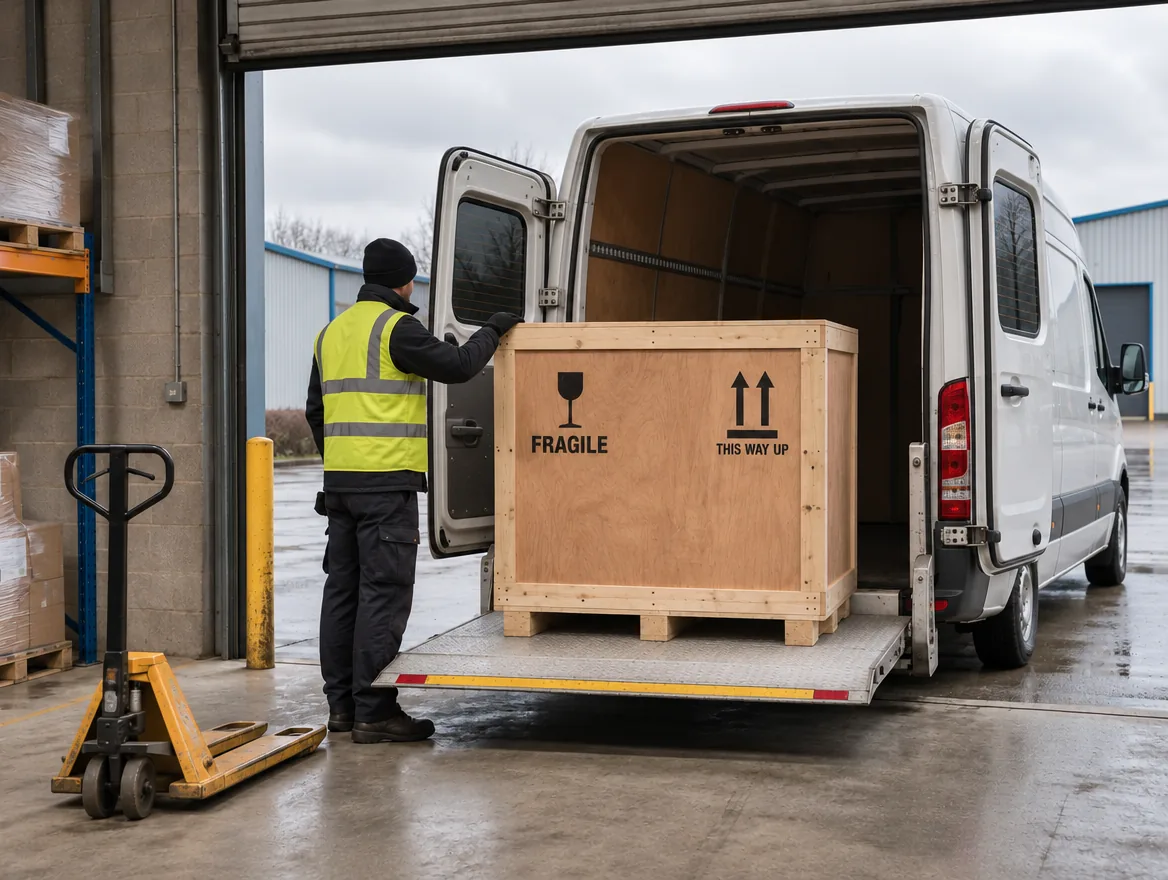
We collect the instrument in its case, check how it's packed inside, and build the crate around it at our warehouse. Your courier or shipper then collects the finished crate from us. Collect and crate
Send us the measurements of the case, what's in it and roughly what it weighs. We confirm the sizes with you before we build, then deliver the crate to your address. Crates built to your measurements
Common questions
Can I ship a guitar without a case? +
We'd always rather it travelled in a hard case inside a crate. If there's no case, tell us, and we'll talk through holding the guitar itself in cut foam, with the neck and headstock fully supported.
Should I take the strings off my guitar to ship it? +
No. Slacken them well below pitch but leave them on. With the strings off, nothing balances the pull of the truss rod in the neck, and on guitars with a floating bridge the bridge will fall. Slack, not off.
Do you set up or tune the instrument at the other end? +
No. Set-up, tuning and any repairs are for your luthier, guitar tech or repairer. Most instruments need tuning back up after a journey, and a violin shipped with the bridge down needs a luthier to set it up.
Can several guitars share one crate? +
Yes, as long as each case has its own space and its own foam, with nothing touching. Send us the list and the case sizes and we'll suggest the best layout.
Do you ship double basses and harps? +
Yes. We crate any object, item and weight. Large instruments like these need a crate built around their case or the instrument itself, so send us the sizes and a photo.
Can an amplifier or a pedalboard go in the same crate? +
Yes, each in its own space. Heavy items like amplifiers are held on firm foam and never rest on an instrument case. Tell us everything you want to send and we'll plan the layout.
How much does it cost to ship a musical instrument? +
Every quote is bespoke, based on the instrument and its case: the size, weight, how fragile it is, where it's going and how quickly. Send us the details and we'll come back with a price.
Is the instrument insured in transit? +
Transit insurance is available for every export. It's bought by you, job by job, so the cover matches the instrument being shipped. We also have public and product liability insurance.
Related
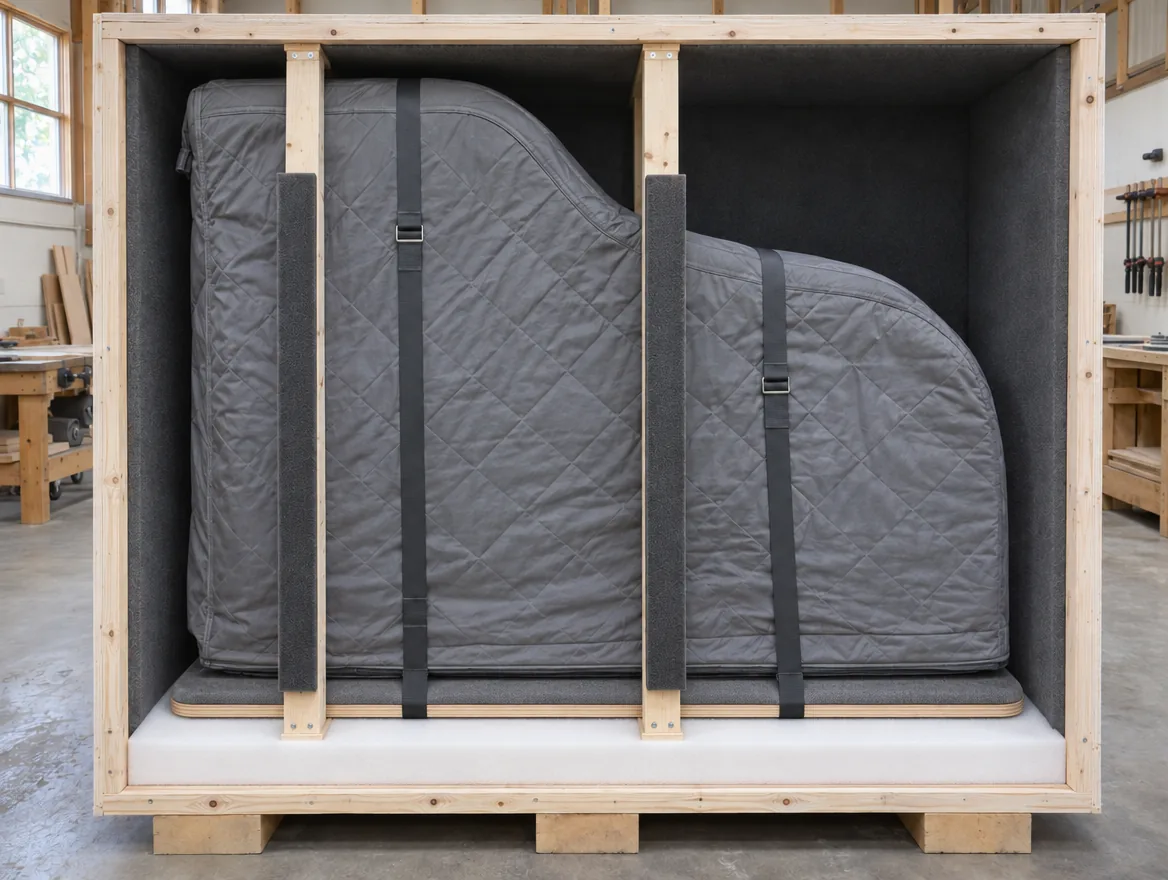
Grands on their side, uprights standing, crated on skids.

We collect from the saleroom, crate it and get it to your shipper.
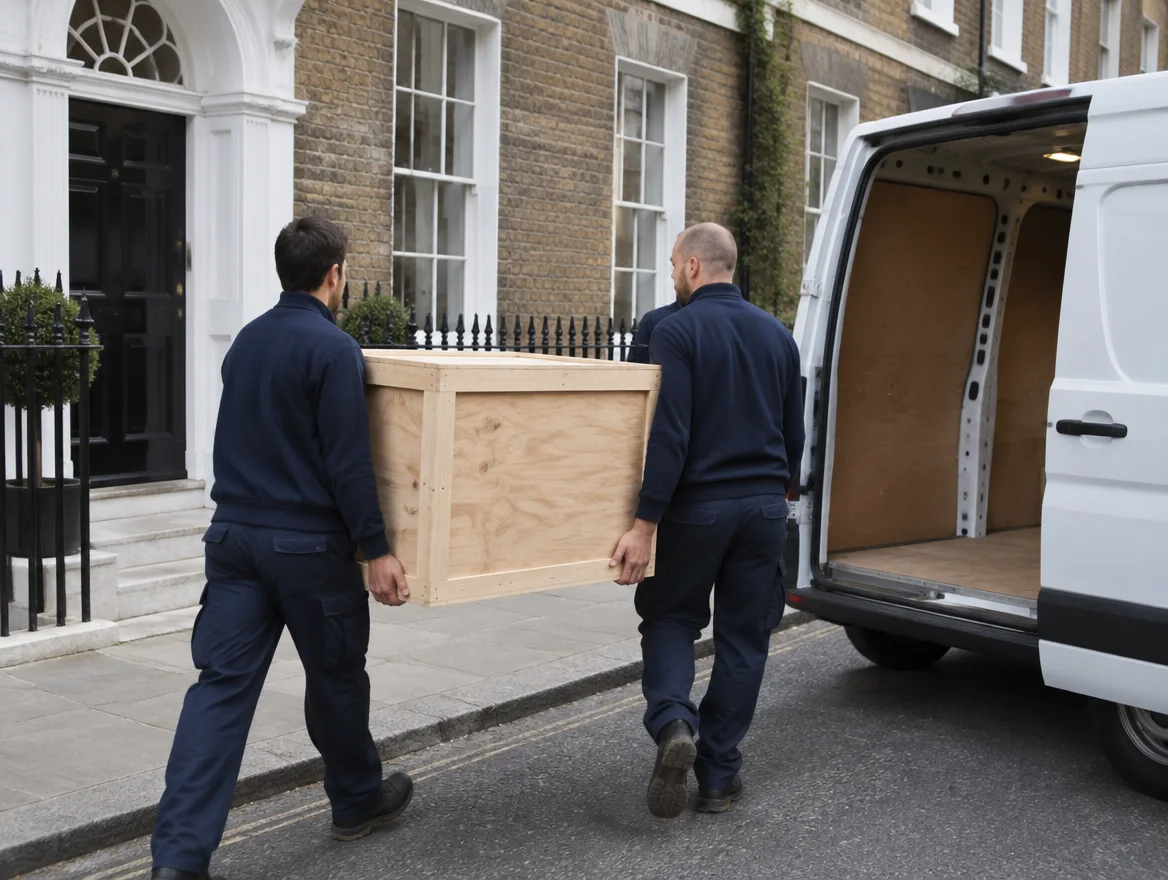
Nothing to measure. We build the crate around the piece.
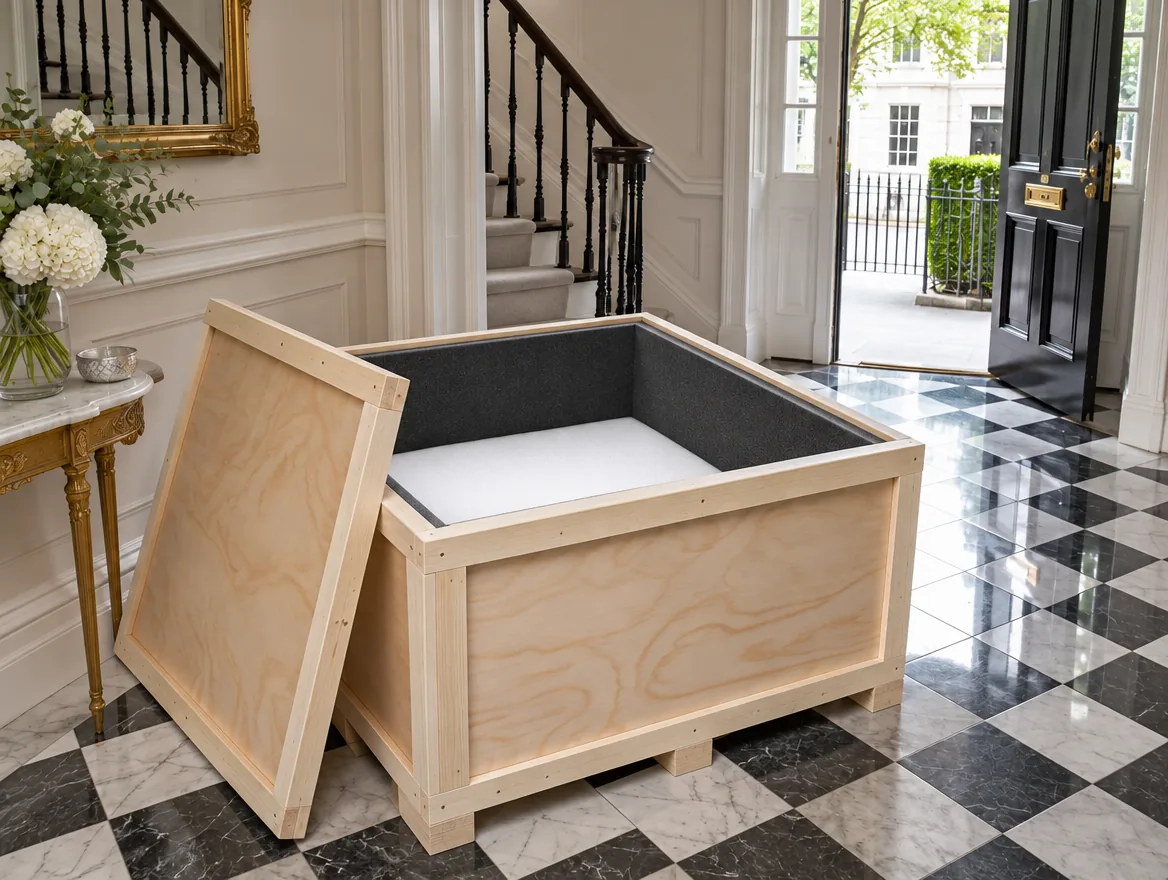
You measure, we confirm, build and deliver.
Swipe for more →
Tell us what needs to travel.
Every quote is bespoke, based on the piece itself. Send us the details and we'll come back to you.